


I Live Near Atta Market, Noida Sector 18 — Where Do I Get My Polio Leg Treated? (Honest Answer)
Every day, thousands of people with polio-affected legs pass through Noida Sector 18 — through the crowded lanes of Atta Market, across the air-conditioned corridors of DLF Mall of India and The Great India Place, past the Sector 18 Metro Station on the Blue Line. Some are limping visibly. Some are pressing their hand on their knee with every step. Some have a worn-out metal caliper that has not been properly assessed in years. All of them are searching, at some point, for the same thing: a specialist who actually understands what a polio-affected leg needs.
This blog answers that search directly. Not with a list of general orthopedic hospitals near Sector 18 — there are already enough of those nearby. Instead, this is a focused, honest guide to what polio leg treatment actually requires in 2026, why most Noida Sector 18 clinics and hospitals cannot fully provide it, and where the closest specialist orthotic care is for anyone living in or around this area.
If you are a polio survivor near Noida Sector 18 — or you are a family member or caregiver looking for answers — read this in full. The information here could directly change how you walk, how much pain you experience, and how independently you live for the next decade.
The Honest Reality of Polio Care in Noida Sector 18 Right Now
Noida Sector 18 is one of the best-connected and most medically served areas in Uttar Pradesh. Max Multispeciality Centre is minutes away in Sector 19. Kailash Hospital and Fortis are accessible. The Blue Line metro connects the sector to Delhi and beyond. Yet walk into any of these facilities asking specifically for a certified orthotist who can assess your polio-affected leg, prescribe a custom KAFO, fabricate it in carbon fibre or polypropylene, and guide you through gait rehabilitation — and you will draw blank looks.
This is not a criticism of those facilities. It is a structural reality about Indian healthcare. Polio management does not belong to the surgeon — it belongs to the orthotist. And dedicated orthotist-led clinics with full in-house KAFO fabrication capability, biomechanical gait assessment, and post-polio syndrome expertise simply do not exist in Noida Sector 18 or its immediate surrounding sectors. This gap has real consequences for the thousands of polio survivors who live, work, and shop in this catchment every single day.
What most people don't know: An orthopedic surgeon treats bones and joints surgically. An orthotist designs and fits external support devices — braces, KAFOs, AFOs, calipers — based on biomechanical assessment. For polio leg management, you need an orthotist. Most hospitals near Sector 18 don't have one. The Rehab Street does — and it is 20 minutes away via DND Flyway.
5 Signs Your Polio Leg Needs a Specialist Assessment Right Now
Many polio survivors in Noida Sector 18 have been managing with the same device — or with no device at all — for years or decades. Here are the five clearest signs that your current situation needs professional intervention:
1. You press your hand on your knee or thigh while walking (hand-knee gait). This is the most urgent sign. It means your quadriceps cannot stabilise your knee, and you are compensating with your shoulder and wrist — causing progressive damage to those joints that often becomes irreversible.
2. Your current caliper or brace is more than 3 years old and has not been assessed by a specialist. Orthotic materials degrade. Joint mechanisms wear. And if your body weight, muscle function, or gait has changed — which it almost certainly has — the prescription is no longer accurate.
3. You have had a fall or near-fall in the past 12 months related to your polio leg. Falls in polio patients are never coincidental. They are signals from your body that the current level of support is inadequate.
4. You are more tired walking than you were 2–3 years ago, even over the same distances. This is a classic early sign of post-polio syndrome — the gradual failure of overworked motor neurons decades after the original infection. Your orthotic prescription may need upgrading.
5. You have new pain in your shoulder, wrist, lower back, or hip. Polio survivors who compensate for leg weakness through abnormal walking patterns or hand-knee gait develop predictable secondary joint problems in these areas. New pain in these locations is your body's bill for years of mechanical compensation.
If any of these five apply to you, the right response is not to wait or manage with painkillers. It is to get a specialist orthotic assessment — ideally within the next few weeks, not the next few years.
What 'Polio Leg Treatment' Actually Means in Clinical Terms
When most people in Noida Sector 18 search for polio leg treatment, they imagine a device — a caliper, a brace, a KAFO. And a device is certainly the centrepiece of management. But the device is only as good as the clinical thinking that produced it. Polio leg treatment, done correctly, involves four interconnected components:
Component 1: Precise Biomechanical Assessment
Before any device is prescribed, a specialist orthotist needs to know exactly which muscles are functioning, which are absent, and how the affected leg behaves during walking. This involves manual muscle testing (grading strength at each joint from 0 to 5), joint range of motion assessment (looking for contractures or deformity), and observational gait analysis (watching the full walking pattern and identifying every compensatory movement and its cause). Without this, the prescription is guesswork.
Component 2: Individually Prescribed Orthotic Device
Based on the assessment, the orthotist prescribes the most appropriate device. This might be a KAFO (Knee Ankle Foot Orthosis) if the knee is unstable, an AFO if only the ankle and foot are affected, or an HKAFO if the hip is involved. Within each category, the material (polypropylene, carbon fibre, metal), the joint mechanism (drop-lock, stance control, hinged), and the structural features (heel cup depth, trim lines, ankle angle) are all individually specified. A custom device is then fabricated from a cast or 3D scan of the patient's limb. See our full range of custom orthotics and bracing solutions at The Rehab Street.
Component 3: Gait Rehabilitation
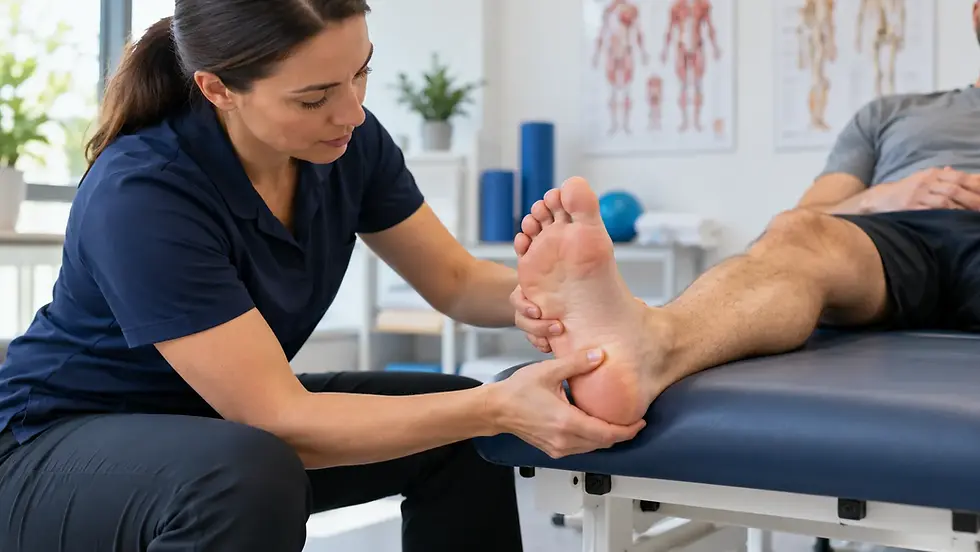
Receiving a new orthosis is not the end — it is the beginning. Learning to walk correctly with a new device, gradually building wearing time, understanding how to manage stairs and uneven terrain, and complementing the orthosis with targeted foot and leg exercises is essential. The Rehab Street's foot therapy programme provides exactly this alongside orthotic management, ensuring patients get the full functional benefit of their device rather than just wearing it.
Component 4: Long-Term Follow-Up and Adaptation
Polio is a lifelong condition. The orthotic prescription that is correct today may not be correct in three years — particularly if post-polio syndrome begins to progress, if body weight changes significantly, or if the patient's activity level changes. A specialist clinic builds long-term relationships with polio patients, reviewing and adapting the prescription as needed. This is not a one-time transaction.
The Sector 18–DND Flyway–Greater Kailash Route: Closer Than You Think
One of the most common reasons polio survivors in Noida Sector 18 have not sought specialist orthotic care is the assumption that Delhi clinics are far, expensive to reach, and time-consuming. The reality in 2026, with the DND Flyway operating smoothly, is very different.
Noida Sector 18 sits literally at the base of the DND Flyway — one of the most efficient road connections between Noida and Central/South Delhi. From Atta Market or the Sector 18 Metro Station, a cab to Greater Kailash 2 via the DND takes approximately 20–28 minutes in normal traffic, and 30–40 minutes in peak conditions. The Rehab Street's Delhi clinic at H-13, near Balwant Rai School, Greater Kailash 2 is less than 15 km from the sector.
For patients who prefer metro travel, the Blue Line from Sector 18 connects to central Delhi stations from where a short cab reaches Greater Kailash. The Gurgaon clinic at Sector 50 is also accessible in 45–60 minutes via DND and NH-48 — useful for Sector 18 patients who commute toward Gurgaon.
Practical tip: Book your Rehab Street appointment for a weekday mid-morning (10:30 AM–12:00 PM). The DND Flyway is clear at this time and the Sector 18 to Greater Kailash 2 journey is consistently under 25 minutes. Plan for a 90-minute appointment at the clinic for a full first assessment.
Which Polio Orthotic Device Is Right for You? A Quick Reference
Your Situation | Device Recommended | Why This Device |
Knee buckles / bends backward when walking | KAFO with drop-lock knee joint | Quadriceps absent — knee needs external locking in stance |
Foot drops / toes drag / trips on kerbs | Custom AFO — posterior leaf spring or solid ankle | Tibialis anterior weak — needs dorsiflexion assist |
Hand on knee while walking every step | KAFO — urgent prescription | Classic quadriceps weakness sign; protects shoulder and wrist |
Ankle rolls inward / frequent ankle sprains | AFO with mediolateral control | Weak peroneals — lateral ankle instability needs control |
Hip drops on swing side / excessive trunk lean | HKAFO | Hip abductor weakness — pelvis needs pelvic support |
Old caliper feels loose / worn / painful | Full reassessment + device replacement | Material degraded; prescription likely outdated |
More tired walking than 2 years ago | Specialist PPS review + possible device upgrade | Possible post-polio syndrome — motor neuron loss progressing |
Shorter affected leg / limping gait | Customised shoe raise + orthopedic footwear | Leg length discrepancy causing pelvic tilt and back pain |
Living With Polio in Noida Sector 18: The Daily Challenges No One Talks About
Noida Sector 18 is a vibrant, busy, physically demanding environment. Atta Market is dense and uneven underfoot. DLF Mall of India has long walking distances across multiple floors. The Great India Place and Wave Mall involve ramps, escalators, and polished marble floors. The Sector 18 Metro Station has stairs and platforms. Film City and the nearby corporate offices involve long daily commutes on foot.
For a polio survivor with an inadequate orthosis — or none at all — Sector 18's physical environment is genuinely hazardous. Polished floors increase fall risk. Crowded markets make compensatory gait patterns harder to manage. Long mall distances exhaust muscles that are already overworked. The DND Flyway underpass roads and footpaths are uneven. None of this is insuperable with the right orthosis — but with a worn-out caliper or without one at all, it becomes progressively limiting.
We hear this regularly from patients who travel from Noida Sector 18 to The Rehab Street for the first time: they had been unconsciously shrinking their world — avoiding Atta Market on busy days, skipping events at GIP, staying closer to home — because walking had become too unpredictable and exhausting. The right KAFO or AFO, properly fitted, reverses this. Patients return to full participation in the Sector 18 lifestyle — including all its commercial hustle and physical demands — with confidence.
Why Carbon Fibre KAFOs Are Changing Polio Management — And Why Sector 18 Patients Should Know
Most polio survivors in Noida are familiar with the traditional metal-leather caliper — heavy, visible under clothing, making a distinctive clicking sound with each step. Many have worn one for decades. What most do not know is that carbon fibre KAFOs — available at The Rehab Street — have fundamentally changed what is possible for polio patients in terms of device weight, walking efficiency, and quality of life.
Carbon fibre composite KAFOs are approximately 28–30% lighter than polypropylene equivalents and significantly lighter than metal-leather devices. Their elastic modulus allows them to store energy during the loading phase of walking and return it at push-off — functioning almost like a passive spring that assists propulsion. Clinical research consistently shows that patients switching from conventional KAFOs to carbon composite devices walk faster, walk further, and report significantly less fatigue — a critical benefit for polio survivors already dealing with the energy drain of post-polio syndrome.
For Sector 18 residents who are professionally active, commute daily on the metro, or walk significant distances through the markets and malls of the area — a carbon KAFO from The Rehab Street can meaningfully expand what is possible. It is an investment in daily function, not just medical management. Explore our full orthotics and bracing service to understand the full range of options.
Post-Polio Syndrome — The Condition Affecting Thousands of Noida Sector 18 Polio Survivors That Nobody Is Talking About
India's polio eradication campaign declared success in 2014. But for the millions of survivors of earlier decades' polio epidemics — many of whom now live in working-age communities like Noida Sector 18 — the disease is not finished. Post-polio syndrome (PPS) is the slow, progressive weakening of muscles in previously polio-affected limbs, typically emerging 30–40 years after the original infection.
The mechanism: when polio destroyed motor neurons, the surviving neurons compensated by sprouting additional connections and taking over the function of dead neurons — a heroic but unsustainable arrangement. After 30–40 years of this overwork, the surviving neurons begin to fail. Muscles that had been stable weaken again. Walking becomes more tiring. Distances that were manageable become exhausting. Falls begin to happen.
A polio survivor who was 5 years old during the 1980s infection is now in their mid-40s — exactly the age when PPS typically begins to manifest. If this describes you or someone in your family in Noida Sector 18, the pattern you are experiencing is not 'just getting older.' It is a recognised medical condition with effective orthotic management options.
The Rehab Street provides specialist post-polio syndrome assessment, orthotic prescription review, and device upgrading — including transition from AFO to KAFO when quad weakness has progressed, and from standard KAFO to carbon composite when fatigue management is the priority. Read more about our braces and splints services and book a PPS review today.
Footwear for Polio Near Noida Sector 18: Why the Wrong Shoe Undoes the Right Brace
One aspect of polio leg management that receives almost no attention in most orthotic clinics — but is taken seriously at The Rehab Street — is footwear. The shoe worn with a KAFO or AFO is not interchangeable with any available commercial option. It needs to have adequate internal depth to accommodate the orthotic device without compressing the foot. It needs a firm heel counter that does not collapse under the corrective forces the KAFO is applying. And for patients with leg length discrepancy — common in polio survivors — the shoe may need a built-in heel or sole raise to level the pelvis and prevent the secondary back pain and scoliosis that an uncompensated short leg causes over years. The Rehab Street's customised orthopedic footwear service addresses all of these requirements — providing footwear that works with the orthosis, not against it.
For residents of Noida Sector 18 who frequently shop at Atta Market, DLF Mall, or online for their footwear — the availability of stylish, commercially available shoes is not matched by availability of shoes appropriate for KAFO and AFO use. This is a practical problem our team helps patients solve at every assessment.
About The Rehab Street — Delhi NCR's Specialist Foot and Lower Limb Orthotic Clinic
The Rehab Street is not a general physiotherapy centre or a medical equipment shop. It is a specialist foot and ankle orthotic clinic — operating at Greater Kailash 2, New Delhi and Sector 50, Gurgaon — whose entire clinical focus is the assessment, prescription, fabrication, and fitting of custom lower limb orthotic devices. Every member of our clinical team is trained specifically in orthotics and lower limb biomechanics. Polio management is one of our core clinical areas.
We see patients from across the NCR — Delhi, Noida, Greater Noida, Gurgaon, Faridabad, Ghaziabad — and from further afield across India. Patients travel from Noida Sector 18, Atta Market, DLF Mall catchment areas, and all surrounding sectors specifically because there is no equivalent specialist service available locally in Noida. We understand this — and we make the process as smooth as possible, from direct online booking to same-week availability to a single comprehensive first assessment that covers everything we need to fabricate the right device.
Clinic Addresses and Directions from Noida Sector 18
Delhi Clinic — Closest to Noida Sector 18
H-13, near Balwant Rai School, Greater Kailash - 2, Masjid Moth, Greater Kailash, New Delhi, Delhi 110048
From Sector 18 Noida: Take the DND Flyway northbound toward Delhi → exit toward Maharani Bagh → continue to Ring Road → Greater Kailash 2. Approximately 15 km, 20–30 minutes by car or cab.
Gurgaon Clinic
Nirvana Courtyard, C-616, Market, Sector 50, Gurugram, Haryana 122018
From Sector 18 Noida: DND Flyway → Delhi Ring Road → NH-48 toward Gurgaon → Sector 50. Approximately 35–50 minutes.
Connect With The Rehab Street Online
🌐 Website: www.therehabstreet.com
📸 Instagram: @therehabstreet
👍 Facebook: facebook.com/therehabstreet
💼 LinkedIn: linkedin.com/company/therehabstreet
▶️ YouTube: @therehabstreet2211
10 Questions Noida Sector 18 Polio Patients Ask Most
Q1. I have been using the same metal caliper for 8 years. Should I get it reassessed?
Yes — without question. After 8 years, a metal caliper's knee joint mechanism is almost certainly worn, the leather has stretched and lost its original fit, and the overall alignment may no longer match your current limb shape or muscle function. More critically, if your condition has changed — through ageing, post-polio syndrome, weight change, or secondary joint problems — the prescription itself may be completely outdated. An 8-year-old caliper fitted to your 8-years-younger body is not the same device you need today. A specialist assessment at The Rehab Street will determine what you actually need now.
Q2. I live near Atta Market. Is The Rehab Street really accessible from here?
Yes — far more accessible than most people assume. The DND Flyway originates in Noida Sector 15A, which borders Sector 18. A cab from Atta Market or the Sector 18 Metro Station to The Rehab Street's Delhi clinic in Greater Kailash 2 consistently takes 20–30 minutes during non-peak hours and 30–40 minutes in peak conditions. This is shorter than many within-Noida journeys to hospitals in Sectors 25 or 27. The distance is approximately 14–15 km.
Q3. My doctor at a Noida hospital told me I don't need a new KAFO. But I am struggling to walk. What should I do?
An orthopaedic surgeon at a hospital assesses whether surgery is needed. They are not typically trained to assess whether an orthotic prescription is adequate, whether a KAFO is correctly fitted, or whether a device upgrade is clinically warranted. These questions require assessment by a certified orthotist. If you are struggling to walk with your current device — or without one — a specialist orthotist's assessment at The Rehab Street will give you a direct, clinical answer independent of surgical opinion.
Q4. What is the difference between post-polio syndrome and just getting older?
Both cause fatigue and reduced strength — but post-polio syndrome has a specific pattern: the new weakness occurs in muscles that were previously affected by polio (not necessarily the same muscles that were paralysed, but those that were working harder to compensate). It also tends to progress gradually, is associated with new muscle pain and joint pain, and occurs at a specific life stage — typically 30–40 years after the original infection. If you had polio as a child and are now in your 40s or 50s and noticing new weakness or fatigue in the affected limb — this is worth discussing with a specialist.
Q5. Can someone from Noida Sector 18 get a carbon fibre KAFO made at The Rehab Street?
Yes. The Rehab Street fabricates carbon composite KAFOs for appropriate patients — those who are sufficiently active, whose body weight and limb shape are suitable for carbon construction, and whose functional requirements would benefit from the lighter weight and energy-return properties of carbon fibre. The suitability assessment is part of the initial clinical evaluation. Not every patient needs or benefits from carbon; for those who do, it produces measurable improvements in walking distance, speed, and fatigue level.
Q6. How does hand-knee gait damage the shoulder and when does the damage become permanent?
In hand-knee gait, the arm bears a portion of the body's forward thrust with each step — a load the shoulder was never designed to handle repetitively. This causes progressive wear of the rotator cuff tendons, impingement of the shoulder bursa, and eventually joint arthritis. The timeline varies — some patients develop significant shoulder pathology within 10 years of sustained hand-knee gait; others take 20 years. The damage is typically irreversible once rotator cuff tears develop. A KAFO that eliminates hand-knee gait on the first day of use prevents all of this. It is one of the most important interventions for preserving long-term upper limb function in polio survivors.
Q7. Is foot therapy useful for a polio patient or is orthosis the only treatment?
Foot therapy is a valuable complement to orthotic management. The muscles that remain functional in a polio-affected limb — partial quadriceps, hip extensors, intact calf on the unaffected side — can be strengthened through targeted therapy, improving overall walking efficiency and reducing the mechanical load on the orthosis. The Rehab Street's foot therapy programme is specifically designed to work alongside orthotic management, not as an alternative to it. Patients who combine a correctly fitted KAFO with an active strengthening programme consistently achieve better functional outcomes than those who rely on the orthosis alone.
Q8. I have a shorter leg from polio. Can that be corrected with a special shoe?
Yes. Leg length discrepancy — extremely common in polio survivors due to reduced bone growth in the affected limb during childhood — is managed with a heel raise or full sole raise built into the shoe. The raise height is calculated based on a precise measurement of the discrepancy. Without compensation, an unequal leg length causes pelvic obliquity, compensatory scoliosis, and chronic lower back pain over time. The Rehab Street provides customised orthopedic footwear including raised shoes designed to work alongside KAFO and AFO devices.
Q9. How many clinic visits are needed to get a custom KAFO from start to finish?
For most patients, the process involves three clinic visits: the initial assessment and casting (90 minutes), the fitting appointment where the fabricated device is tried and adjusted (60 minutes), and a follow-up review 4–6 weeks later to confirm fit and function. Patients from Noida Sector 18 travelling via the DND Flyway can typically complete all three visits within a 6–8 week period. Urgent cases can be prioritised. The Rehab Street's same-week assessment availability means there is usually no long wait for an initial appointment.
Q10. How do I book and what should I bring to my first appointment?
Book directly at www.therehabstreet.com — no referral letter needed. To your first appointment, bring: your current orthotic device (KAFO, caliper, or AFO) if you have one, any previous X-rays or medical reports related to your polio, a list of medications, and comfortable, loose-fitting clothing so the orthotist can assess the affected leg easily. Wear the shoes you normally use daily. Find us on Google Maps at our Delhi clinic (H-13, Greater Kailash 2) or Gurgaon clinic (Nirvana Courtyard, Sector 50). Follow us on Instagram and YouTube for patient education content before your visit.
The Bottom Line for Polio Survivors in Noida Sector 18
Noida Sector 18 is one of the most liveable, connected, and commercially rich areas in the NCR. For polio survivors, living in or near it should mean full access to everything it offers — the markets, the malls, the metro, the professional opportunities. But that access depends entirely on having a lower limb orthotic solution that actually matches your current condition — not the condition you had when your last caliper was made five, eight, or fifteen years ago.
The specialist orthotic care that makes that possible is not available within Sector 18 itself. But it is available 20 minutes away — at The Rehab Street, Greater Kailash 2. No referral. Same-week appointments. Carbon fibre KAFOs. Stance control devices. Post-polio syndrome management. Customised footwear. Gait rehabilitation. Everything needed for comprehensive, expert polio leg treatment — for Sector 18 residents who are ready to stop settling for inadequate care and start walking with the support they actually deserve.


Comments