


Foot Brace for Stroke & Foot Drop: The Complete Guide to AFO, Recovery, and Getting Back on Your Feet

If you or someone you love has recently had a stroke, one of the most distressing changes you may have noticed is the sudden inability to lift the front part of the foot while walking. The toes drag on the ground. The foot slaps down with each step. Falls become a constant fear. This condition is called foot drop — and it is one of the most common and disabling consequences of stroke.
The good news is that foot drop is treatable. A properly prescribed foot brace — clinically known as an Ankle Foot Orthosis or AFO — can restore safe walking, significantly reduce fall risk, and meaningfully improve quality of life from the very first day it is worn. For many stroke survivors, it is the single most impactful piece of rehabilitation equipment they will ever use.
This guide is written for stroke survivors, their families, and caregivers who want to understand what foot drop actually is, why it happens after a stroke, what the different types of foot braces are, how to choose the right one, and what a specialist assessment and fitting process looks like. By the end, you will know exactly what to ask for and where to go for help.
Understanding Foot Drop After Stroke
Foot drop is not a disease in itself — it is a symptom of neurological damage. After a stroke, part of the brain loses its blood supply, and the nerve pathways that control movement in the leg and foot are interrupted. When the motor signals from the brain cannot reach the muscles responsible for lifting the foot — primarily the tibialis anterior muscle at the front of the shin — those muscles weaken or become paralysed.
The result is that during walking, the affected foot cannot clear the ground during the swing phase (when the leg moves forward). Instead of lifting cleanly, the toes drop downward and drag along the floor. To compensate, the person may hike the hip upward, swing the leg in a wide arc (circumduction gait), or lean forward excessively. These compensatory patterns are not just tiring — they put enormous stress on the knee, hip, and lower back over time, creating new pain and problems on top of the original condition.
Foot drop can also be accompanied by spasticity — involuntary muscle stiffness or tightness — which further complicates walking and positioning of the foot. In some stroke survivors, the ankle turns inward (inversion) or the heel cannot properly contact the ground. All of these are within the scope of what a correctly prescribed AFO foot brace is designed to address.
How Common Is Foot Drop After Stroke?
Foot drop is estimated to affect approximately 20–30% of stroke survivors. Among those who experience it, many will have some degree of permanent residual weakness even after rehabilitation — making ongoing orthotic support an important long-term component of their care. The condition is particularly common in strokes that affect the motor cortex or the internal capsule region of the brain, which are the main pathways for voluntary lower limb movement.
What Is a Foot Brace for Stroke? Understanding the AFO
A foot brace for stroke — formally called an Ankle Foot Orthosis (AFO) — is a custom-fitted or prefabricated device that supports the ankle and foot in the correct position during standing and walking. It extends from just below the knee down to a foot plate that sits inside the shoe, holding the ankle at approximately 90 degrees (neutral position) so that the foot does not drop during the swing phase of gait.
The AFO essentially acts as an external substitute for the muscles and nerve pathways that the stroke has damaged. It does not cure the underlying neurological impairment, but it immediately restores functional walking — making it safe to walk without tripping or falling — while rehabilitation and neuroplasticity work on longer-term recovery.
AFOs are the most commonly prescribed orthotic device for stroke survivors worldwide. They are backed by decades of clinical evidence showing improvements in walking speed, step length, energy efficiency, balance, and quality of life. When prescribed correctly and fitted by an experienced orthotist, an AFO is transformative.
Signs That a Stroke Survivor Needs a Foot Brace
Many families are unsure whether a foot brace is needed or when to seek an assessment. Here are the key signs that an AFO evaluation is warranted following a stroke:
• The foot drags or scuffs on the ground when walking
• The toes catch on steps, rugs, or uneven surfaces causing trips or near-falls
• The person swings the leg outward or hitches the hip up to clear the foot
• The ankle turns inward during walking, causing the person to roll onto the outer edge of the foot
• The heel does not strike the ground first — the foot slaps flat or the toes land first
• The person feels unsteady or fearful when walking on uneven ground
• Falls have occurred during walking or transfers
• The affected leg feels heavy and tiring to move forward
• The person is pressing their hand on their thigh or knee to help propel the leg forward
If any of the above apply, an assessment with a specialist orthotist should be arranged as early as possible. The sooner appropriate orthotic support is introduced, the more effectively it can support neuroplasticity — the brain's own process of rewiring and recovering function — during the critical early rehabilitation window.
Types of Foot Brace for Stroke Patients
Not all AFOs are the same, and the wrong type can actually hinder recovery. The correct prescription depends on the degree of foot drop, the presence of spasticity, the pattern of muscle weakness, ankle range of motion, and the patient's activity level and goals. Here is a guide to the main types:
Type of AFO | Best For | Key Characteristic |
Posterior Leaf Spring (PLS) AFO | Mild to moderate foot drop, no spasticity | Flexible, energy-storing posterior shell; lightest option |
Solid Ankle AFO | Moderate spasticity, ankle instability, equinus | Rigid; holds ankle firmly at 90°; maximum control |
Hinged (Articulated) AFO | Good ankle range of motion, moderate weakness | Allows plantarflexion/dorsiflexion; more natural gait |
Floor Reaction AFO | Weak quadriceps (knee buckling); crouch gait | Ground reaction force stabilises the knee |
Carbon Fibre Dynamic AFO | Active patients; energy return needed | Lightest; stores and releases energy during walking |
Prefabricated (Off-the-Shelf) AFO | Immediate temporary use; mild foot drop | Not custom; useful early; replaced with custom device |
KAFO (Knee Ankle Foot Orthosis) | Knee + ankle weakness; severe hemiplegia | Extends to thigh; for combined knee-ankle instability |
Posterior Leaf Spring AFO
The most commonly prescribed AFO for stroke-related foot drop where spasticity is absent or mild. It consists of a thin, flexible polypropylene shell running up the posterior (back) of the lower leg, trimmed to allow some ankle movement. The spring-like flex of the material provides a gentle dorsiflexion assist, lifting the foot during swing. It is light, fits inside most shoes, and allows a relatively natural walking pattern.
Solid Ankle AFO
For stroke survivors with moderate to severe spasticity, the solid ankle AFO provides firmer control. The ankle is fixed at a set angle (usually neutral or slight dorsiflexion), preventing both inversion and plantarflexion. This is the best choice when the ankle tends to turn inward forcefully or when the equinus posture (walking on tiptoe) is present due to spasticity. The trade-off is slightly reduced ankle motion during walking.
Hinged (Articulated) AFO
The hinged AFO features a mechanical joint at the ankle, allowing controlled movement in one or both directions while blocking unwanted motion. For stroke survivors who have some voluntary ankle movement but need assistance with foot clearance, a hinged AFO with a dorsiflexion assist spring produces a more natural gait pattern than a solid ankle device. It is also more comfortable for prolonged daily use.
Carbon Fibre Dynamic AFO
For more active stroke survivors — those who walk longer distances or have returned to work — carbon fibre AFOs represent the gold standard. They are 30–40% lighter than polypropylene alternatives, and their energy-storing properties return spring energy at toe-off, reducing the metabolic cost of walking. Studies consistently show improved walking speed and reduced fatigue with carbon fibre devices in appropriate candidates.
Floor Reaction AFO
A specialist device for stroke survivors who not only have foot drop but also experience knee buckling (inadequate quadriceps control). The floor reaction AFO uses ground contact forces to push the tibia backward, creating a knee extension moment that stabilises the knee during stance. It is a more advanced prescription requiring careful orthotist assessment.
What Makes the Right Foot Brace for a Stroke Patient?
With so many options available, the most important thing to understand is this: the best foot brace for a stroke patient is never a generic off-the-shelf product chosen online. It is a custom device, individually designed and fitted by a trained orthotist who has assessed your specific neurological presentation, muscle function, walking pattern, and goals.
That said, here are the clinical features that determine whether an AFO is genuinely effective for stroke recovery:
• Correct ankle positioning: The foot must be held at or close to 90 degrees so the heel can strike the ground and the toes clear the floor during swing. An AFO that allows too much plantarflexion fails to correct the fundamental problem.
• Appropriate stiffness for the degree of spasticity: Too flexible in the presence of spasticity = inadequate control. Too rigid without spasticity = impaired natural gait mechanics. The trim lines and material thickness determine stiffness and must be matched to the clinical picture.
• Mediolateral stability: The AFO should resist ankle inversion (inward rolling), which is extremely common post-stroke and a major cause of ankle sprains and falls.
• Fit inside footwear: A poorly chosen AFO that cannot fit inside the patient's shoes will not be worn. The device and footwear must be considered as a system.
• Comfort for daily wear: Stroke survivors often have reduced sensation in the affected limb, making them vulnerable to pressure sores and skin breakdown from a poorly fitted brace. Correct contact, smooth edges, and appropriate padding are essential.
• Accommodates spasticity changes: Spasticity often fluctuates with fatigue, time of day, and temperature. The AFO needs to be designed with enough accommodation to remain functional across these variations.
Does an AFO Cure Foot Drop After Stroke?
This is one of the most important questions families ask, and it deserves an honest, clear answer. An AFO does not cure foot drop. It manages it. The device compensates for the absent or weak dorsiflexors by mechanically holding the foot up, enabling safe and functional walking immediately — but it does not repair the underlying neurological damage.
However, neurological recovery from stroke is possible through a process called neuroplasticity — the brain's remarkable ability to form new connections and rewire pathways around damaged areas. Neuroplasticity is most active in the first 3–6 months after stroke but continues for years. AFO use supports this recovery process by:
• Enabling active participation in physiotherapy and gait training, which drives neuroplastic change
• Preventing secondary deformities (such as Achilles tendon shortening and equinus contracture) that would make recovery harder if left untreated
• Restoring confidence in walking, encouraging the activity levels that are essential for neurological recovery
• Reducing fall risk, preventing the fear-induced inactivity that is one of the greatest barriers to stroke rehabilitation
Many stroke survivors do achieve partial or full recovery of foot dorsiflexion over time — particularly with intensive, task-specific physiotherapy. For those who do recover, the AFO can be progressively weaned and eventually discontinued. For others, the AFO becomes a long-term tool that enables a full and active life. Either way, wearing it during recovery is the right decision.
Foot Drop Recovery After Stroke: What to Realistically Expect
Recovery from foot drop varies enormously between individuals, depending on the location and severity of the stroke, the person's age and overall health, and the intensity and timing of rehabilitation. Here is a realistic overview of the recovery timeline:
0–3 Months (Acute and Early Subacute Phase)
This is the most critical window for neurological recovery. The brain is in a heightened state of neuroplasticity, and intensive rehabilitation during this phase produces the greatest functional gains. An AFO should be prescribed as early as possible — often within the first few weeks — to enable safe walking practice. Physiotherapy should be daily and task-specific. Many survivors show significant improvement in this period.
3–6 Months (Late Subacute Phase)
Neuroplasticity remains active but begins to plateau. Gains are slower but still meaningful. At this stage, the AFO prescription may need to be reviewed as the degree of spasticity and muscle tone evolves. Some patients who started on a solid ankle AFO may be able to transition to a more dynamic device as voluntary control returns.
6 Months to 2+ Years (Chronic Phase)
The conventional medical view used to be that recovery plateaus after 6 months. More recent evidence strongly challenges this — meaningful improvements in walking function continue for years with the right rehabilitation input. However, those who still have significant foot drop at this stage are likely to need long-term AFO use. A high-quality carbon AFO or dynamic device at this stage supports an active life without limiting what the patient can do.
Post-Polio Syndrome and Long-Term Users
For stroke survivors who have used an AFO for many years, regular orthotist reviews remain important. The original device may wear out, the condition may evolve, or newer materials and designs may offer meaningful improvements in walking efficiency and comfort.
What Happens During an AFO Assessment for Stroke at The Rehab Street?
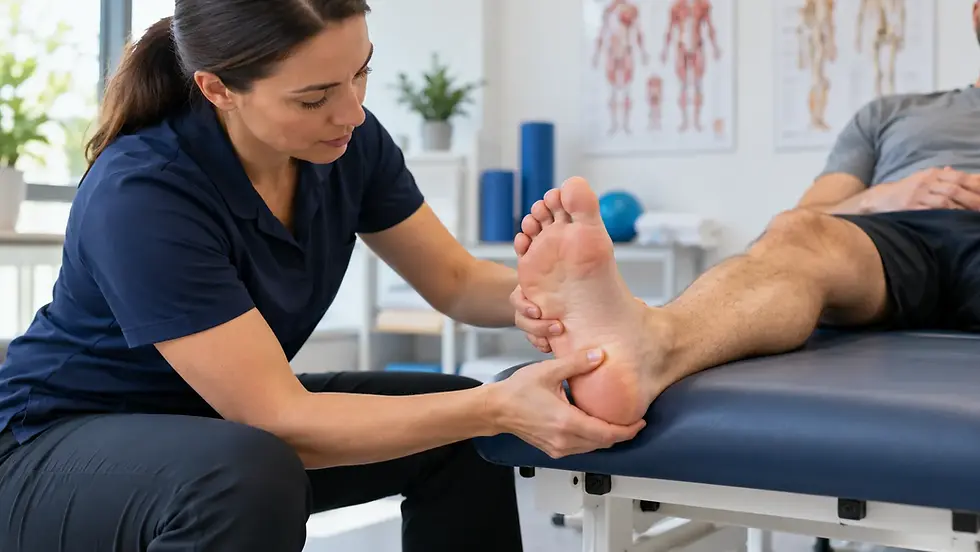
Getting the right foot brace for stroke recovery requires more than a measurement. At The Rehab Street — a specialist foot and ankle clinic in Delhi and Gurgaon — our orthotists conduct a thorough clinical assessment before recommending or fabricating any device. Here is what the process involves:
1. Clinical history and goals: We begin by understanding the details of the stroke — when it occurred, what has been tried so far, what the main functional complaints are, and what the patient's goals are. Goals vary enormously: some patients want to walk safely at home; others want to return to work or outdoor activity.
2. Muscle strength and tone assessment: A systematic manual muscle test of the hip, knee, ankle, and foot muscles identifies which muscles are weak, which are spastic, and which are functioning normally. This determines the level of support the AFO needs to provide.
3. Ankle range of motion: Passive and active range of motion at the ankle is assessed, including testing for spasticity (the stretch reflex response). This determines whether a solid ankle or hinged design is more appropriate.
4. Gait analysis: The patient walks while the orthotist observes the foot, ankle, knee, hip, and trunk at each phase of the gait cycle. Deviations such as foot drop, circumduction, hip hiking, knee recurvatum, or lateral trunk lean are identified and factored into the prescription.
5. Footwear assessment: The shoes the patient currently wears are reviewed. If the shoe cannot accommodate an AFO appropriately, recommendations for suitable footwear are made alongside the orthosis prescription.
6. Casting or scanning: A plaster of Paris cast or 3D digital scan of the lower leg and foot is taken to serve as the mould from which the custom AFO is fabricated.
7. Fabrication and fitting: The custom AFO is manufactured based on the cast and prescription. At the fitting appointment, the device is checked for alignment, fit, and function — including a walking assessment with the AFO in place.
8. Gait training: Our orthotists and physiotherapy team guide the patient and their caregiver through learning to use the AFO correctly, including how to don and doff the device, appropriate wearing schedules, footwear pairing, and what to look out for in terms of skin health.
Practical Tips for Caregivers of Stroke Survivors with Foot Drop
If you are caring for a stroke survivor who has foot drop, here is what you need to know to keep them safe and support their recovery:
• Do not let them walk barefoot on hard floors: Without the AFO, foot drop makes every unbraced step a fall risk. Insist on the brace being worn for all walking, even short distances within the home.
• Ensure footwear is appropriate: The shoe worn with the AFO must have a firm heel counter, adequate depth to accommodate the device, and a non-slip sole. Avoid slippers, sandals, or loose footwear with the brace.
• Check the skin daily: Stroke survivors often have reduced sensation in the affected limb, meaning they cannot feel pressure sores developing. Check the skin under and around the brace every day, particularly over the shin, heel, and ankle bones.
• Encourage consistent wear: The more the patient walks with the AFO, the more neuroplastic change is driven. Consistent use during all walking activity is the goal.
• Watch for changes in fit: As spasticity evolves and muscles change following stroke, the AFO fit and function will change too. If the brace feels loose, painful, or the patient's gait pattern changes, arrange a review appointment.
• Support physiotherapy attendance: AFO use alone is not sufficient for optimal recovery. Regular physiotherapy — focused on walking practice, balance, and strengthening — should accompany orthotic use.
• Remove the brace for skin checks but not for walking: The AFO should be removed regularly to allow skin inspection and hygiene, but always reapplied before the patient stands up to walk.
Complementary Treatments That Work Alongside an AFO for Stroke Recovery
The most successful outcomes after stroke are always achieved through a combination of approaches. The AFO is the mechanical foundation that makes walking safe and possible — but these additional interventions maximise neurological recovery:
Physiotherapy and Gait Training
Task-specific walking practice is the most evidence-based driver of neuroplastic change. Physiotherapy should focus on quality walking with the AFO — working on correct heel strike, stance stability, hip extension, and coordinated arm swing. Repetitive, intensive practice is what signals the brain to rebuild motor pathways.
Functional Electrical Stimulation (FES)
FES devices apply a mild electrical current to the peroneal nerve during the swing phase of walking, stimulating the tibialis anterior to lift the foot. Some patients use FES as an alternative or complement to AFO use. Research evidence supports FES as both a functional walking aid and a therapeutic tool that may improve voluntary dorsiflexion over time. At The Rehab Street, we can advise on whether FES is appropriate alongside or instead of an AFO for individual patients.
Botulinum Toxin (Botox) for Spasticity
For stroke survivors with significant spasticity that is preventing the AFO from positioning the foot correctly, botulinum toxin injections into the overactive muscles (typically the gastrocnemius, soleus, or tibialis posterior) can temporarily reduce tone — creating a window in which the AFO can function more effectively and physiotherapy can achieve better results. Botox is administered by a neurologist or rehabilitation physician and works best as part of a coordinated rehabilitation programme.
Stretching and Ankle Flexibility Exercises
Spasticity and disuse progressively shorten the calf muscles and Achilles tendon after stroke. Daily calf stretching — gentle sustained stretches holding for at least 30 seconds — preserves ankle range of motion and prevents the equinus contracture that would make AFO fitting more difficult. Night-time positioning splints may also be recommended for patients at high risk of contracture.
Balance and Strengthening Exercises
Strengthening the hip abductors, extensors, and knee extensors on the affected side improves the overall quality of gait with the AFO. Balance training on unstable surfaces challenges the neurological system and accelerates the restoration of automatic postural responses that stroke disrupts.
Frequently Asked Questions: Foot Brace for Stroke Patients
How soon after a stroke should a foot brace be fitted?
As soon as the patient is medically stable and able to begin walking practice — which in most cases is within the first few weeks of the stroke. Early AFO use supports neuroplastic recovery during the brain's most receptive window. Waiting months before getting a brace is one of the most common and most preventable mistakes in stroke rehabilitation.
Can foot drop after stroke be permanent?
For some stroke survivors, foot drop does improve significantly or fully resolve with rehabilitation. For others, some degree of residual weakness remains long-term. The extent of recovery depends on the severity and location of the stroke, the intensity and timing of rehabilitation, and individual neurological factors. Even in permanent cases, a well-fitted AFO enables full, active daily life without restriction.
Can I buy an AFO online or at a pharmacy without seeing an orthotist?
Prefabricated AFOs are available off-the-shelf and can be useful as a very short-term interim measure immediately after stroke while a custom device is being made. However, they are not a substitute for a custom AFO. Off-the-shelf devices are not shaped to your limb, do not address your specific pattern of weakness or spasticity, and frequently cause skin problems due to poor fit. For any medium or long-term use, a custom AFO prescribed and fitted by a qualified orthotist is essential.
What is the difference between AFO and KAFO for stroke?
An AFO supports the ankle and foot. A KAFO (Knee Ankle Foot Orthosis) extends the support up to the thigh to also control the knee joint. KAFOs are prescribed for stroke survivors who have both ankle and knee instability — for example, those with severe hemiplegia and significant quadriceps weakness causing knee buckling. Most stroke patients with isolated foot drop are managed with an AFO.
How long does it take to get used to wearing an AFO?
Most patients adapt to their AFO within 2–4 weeks of consistent daily use. Wearing time is built up gradually — starting with 1–2 hours and increasing daily — to allow the skin to adapt and identify any pressure areas requiring adjustment. By the end of the first month, most patients are wearing the device for all daily walking activities.
Does wearing an AFO prevent the foot from recovering?
No — this is a common and damaging misconception. AFO use does not prevent neurological recovery. It enables the active walking practice that drives neuroplastic change. A stroke survivor who is not walking because their foot drop makes it unsafe is getting no neurological stimulus for recovery. The AFO creates the conditions for recovery, it does not block it.
What does a custom AFO cost in India?
Custom polypropylene AFOs typically range from approximately ₹8,000 to ₹20,000 depending on the design complexity, materials, and clinical facility. Carbon fibre dynamic AFOs cost more — typically ₹18,000 to ₹40,000 or above. Prices at The Rehab Street reflect the full clinical process: assessment, casting, custom fabrication, fitting, adjustments, and follow-up care. We can advise on options at your initial consultation.
When Should You See a Specialist for Stroke-Related Foot Drop?
The answer is: now, if you have not already. Foot drop after stroke is not something to wait and see about. Every week without appropriate support is a week of fall risk, compensatory movement damage, missed neuroplastic recovery opportunity, and reduced quality of life.
You should seek a specialist assessment immediately if the stroke survivor:
• Has been discharged from hospital and is still not walking safely due to foot drop
• Is walking but using the hand on the knee or thigh to propel the leg forward
• Has had a fall or near-fall related to the affected foot
• Is currently using a prefabricated AFO that was given at discharge and has not been reviewed
• Has been told by a physiotherapist that an orthotist assessment is recommended
• Is experiencing increasing spasticity or changes in the foot and ankle position
• Wants to improve walking quality, speed, or endurance beyond what they can currently achieve
Why Choose The Rehab Street for Stroke AFO Assessment?
At The Rehab Street, we are specialists in foot, ankle, and lower limb orthotic care — with extensive clinical experience in managing stroke-related foot drop and hemiplegia. Our team of qualified orthotists combines clinical precision with a genuine understanding of what it means to live with the after-effects of stroke day to day.
We do not offer one-size-fits-all solutions. Every patient who comes to us receives a thorough individual assessment, a personalised orthotic prescription, and hands-on follow-up care to ensure the device performs as intended as their condition evolves. Our clinics in Delhi and Gurgaon are equipped with the latest assessment and fabrication capabilities, including carbon fibre composite AFO production for patients seeking the highest performance and lightest possible device.
We also work closely with physiotherapists, neurologists, and rehabilitation physicians to ensure that our orthotic intervention is part of a coordinated, evidence-based rehabilitation plan — not an isolated product sale. Our goal is always your functional independence and the best possible quality of life after stroke.
Final Thoughts: You Do Not Have to Live with Foot Drop
Foot drop after stroke is one of the most visibly disabling consequences of a cerebrovascular event — but it is also one of the most effectively managed. A correctly prescribed, precisely fitted AFO foot brace is not a compromise or a last resort. It is a clinical tool that immediately restores safe, functional walking, supports neuroplastic recovery, and enables the active life that is essential for long-term health and wellbeing after stroke.
Whether you are days out of hospital, months into rehabilitation, or years post-stroke and looking to upgrade an outdated caliper, the right support is available. The earlier you seek specialist orthotic assessment, the better the outcome. Do not let foot drop define your recovery or your life.


Comments