


Best Doctors for Polio Treatment in Noida Sector 17: KAFO, Caliper & Complete Orthosis Solutions Near You

If you are searching for the best doctors for polio treatment in Noida Sector 17, you are not alone. Thousands of polio survivors across Noida, Greater Noida, and the broader NCR region are actively looking for specialist orthotic care — not just a generic physician — who truly understands polio-related leg weakness, knee instability, foot drop, and gait deformities. This 2026 guide is written to give you honest, clinically accurate, and locally relevant information about where to find the right specialist, what polio leg treatment actually involves, and why the right orthotic device can transform your daily life.
Noida Sector 17 sits at the heart of one of India's most densely populated satellite cities. Yet despite the abundance of hospitals and clinics in the area, finding a specialist orthotist — someone trained specifically in fabricating and fitting custom polio calipers, KAFOs (Knee Ankle Foot Orthoses), AFOs, and HKAFOs — remains genuinely difficult. Most orthopedic hospitals in Noida focus on surgical interventions. Polio management, by contrast, is primarily non-surgical and requires a specialist in orthotics and prosthetics with deep experience in lower limb biomechanics.
Key Insight: For polio leg treatment, you need an orthotist — not a general orthopedic surgeon. An orthotist specialises in designing and fitting custom devices like KAFOs and AFOs that compensate for muscle weakness. The Rehab Street, accessible from Noida Sector 17 in under 30–40 minutes, is one of the NCR's only dedicated specialist foot, ankle and lower limb orthotic clinics.
Understanding Polio Leg Problems: What You Are Actually Dealing With
Poliomyelitis attacks the anterior horn cells of the spinal cord, permanently destroying the motor neurons that control specific leg muscles. Unlike a fracture or joint injury, this neurological damage does not repair itself. The muscles controlled by destroyed neurons remain permanently weakened or paralysed — creating a uniquely personal pattern of disability for every survivor, depending on which spinal segments were affected.
What makes polio leg treatment so specialised is the sheer variety of presentations. One patient may have isolated foot drop with a perfectly stable knee. Another may have absent quadriceps causing dangerous knee hyperextension. A third may have bilateral involvement with hip weakness, requiring a full HKAFO. No two polio patients are alike — which is why off-the-shelf braces from a pharmacy or generic caliper fitting without proper biomechanical assessment will always produce inferior results.
Common Polio Leg Conditions Seen in Patients from Noida Sector 17 and Nearby Areas
Condition | What It Means | Orthotic Solution |
Knee Hyperextension (Genu Recurvatum) | Knee bends backward due to weak quadriceps | KAFO with drop-lock or stance-control joint |
Foot Drop | Foot cannot lift during walking; toes drag | AFO (Ankle Foot Orthosis) or KAFO |
Equinus Deformity | Heel cannot contact ground; walking on toes | Solid ankle AFO or KAFO foot component |
Hand-Knee Gait | Hand pressed on knee while walking — sign of absent quads | Urgent KAFO — protects shoulder/wrist long term |
Hip Weakness / Trendelenburg | Pelvis drops during walking; wide trunk sway | HKAFO (Hip Knee Ankle Foot Orthosis) |
Ankle Instability / Inversion | Ankle rolls inward unpredictably | AFO with mediolateral control / polio ankle brace |
Leg Length Discrepancy | Affected limb shorter due to reduced childhood growth | Shoe raise / customised orthopedic footwear |
Post-Polio Syndrome (PPS) | New weakness decades after original polio infection | Orthotic reassessment and upgrade — often KAFO from AFO |
Why Most Hospitals in Noida Are Not the Right Place for Polio Leg Treatment
When families in Noida Sector 17 search for polio treatment, they typically encounter three types of providers: general orthopedic hospitals, physiotherapy clinics, and occasionally prosthetics and orthotics shops. Each has a role — but none fully replaces a dedicated orthotic clinic with specialist assessment capability.
General orthopedic hospitals (like those in Sector 25, Sector 27, or the larger chains) are excellent for fractures, joint replacements, and surgical interventions. For polio, however, their contribution is typically limited to managing complications that require surgery — tendon lengthening for contracture, joint stabilisation for severe deformity. For the day-to-day reality of living with a polio-affected leg, surgery is rarely the answer. What you need is a custom-fitted orthosis designed by someone who understands how the polio-affected leg actually loads during walking.
Physiotherapy clinics offer valuable muscle strengthening and gait training — but cannot fabricate KAFOs or AFOs. A physiotherapist can help you walk better with an orthosis, but cannot prescribe or make the orthosis itself. Prosthetics and orthotics shops that operate without formal clinical assessment often produce devices that look correct but are biomechanically inadequate — causing skin problems, abnormal gait patterns, and joint damage over time.
The Gap: Noida Sector 17 and surrounding sectors have excellent general medical infrastructure. What is missing is a dedicated orthotic specialist who combines clinical assessment, gait analysis, and in-house custom fabrication — the combination that defines effective polio leg treatment. The Rehab Street fills exactly this gap for patients across the NCR region.
The Rehab Street: Specialist Polio Leg Treatment Accessible from Noida Sector 17
The Rehab Street is a specialist foot and ankle orthotic clinic operating at two locations in the NCR — Greater Kailash 2, New Delhi and Sector 50, Gurgaon. Both locations are well-accessible from Noida Sector 17, with the Gurgaon clinic typically reachable in 35–50 minutes via the DND Flyway and Noida-Greater Noida Expressway, and the Delhi clinic accessible via the DND Flyway and Ring Road.
Unlike general orthopedic hospitals, The Rehab Street's clinical model is built entirely around orthotic assessment, prescription, and fabrication. Our orthotists are trained specialists — not generalists — and the clinic's focus on foot, ankle, and lower limb orthotic care means that every patient with a polio-affected leg receives the depth of assessment their condition genuinely requires.
What The Rehab Street Offers for Polio Patients from Noida Sector 17
• Custom KAFO (Knee Ankle Foot Orthosis) — polypropylene, carbon fibre, and metal-leather types
• Polio ankle brace and AFO — for foot drop, equinus, and ankle instability
• HKAFO (Hip Knee Ankle Foot Orthosis) — for bilateral and hip-involved polio
• Stance control KAFO — most advanced option for natural gait restoration
• Post-polio syndrome orthotic assessment and device upgrade
• Customised orthopedic footwear for leg length discrepancy
• Gait analysis and walking rehabilitation training
• No referral required — direct appointment booking available
Polio KAFO and Caliper Types Available at The Rehab Street
One of the most common searches from Noida Sector 17 and nearby areas is for a polio caliper or polio knee brace — the traditional external device that supports the knee and lower limb in polio patients. The Rehab Street fabricates all types, from traditional metal calipers to advanced stance control devices. Here is what each option offers:
Traditional Metal-Leather KAFO (Classic Polio Caliper)
The caliper most people recognise — metal uprights, leather straps, and a mechanical knee lock. Robust, repairable, and affordable. Still widely used across India and appropriate for patients who need a durable, maintainable device. The Rehab Street fabricates these for patients who specifically require or prefer this design, including those from Noida who have been using a metal caliper for years and need a precise replacement.
Polypropylene Custom KAFO
The modern standard. A custom-moulded polypropylene shell fitted to the exact contours of your leg. Lighter than metal-leather, more comfortable for all-day wear, and compatible with a wider range of footwear. Available with multiple knee joint mechanisms — drop-lock, ball-lock, or bail-lock — depending on your functional requirements.
Carbon Fibre KAFO
For active polio patients or those experiencing post-polio fatigue, a carbon fibre KAFO is up to 28% lighter than polypropylene and uses its stored elastic energy to reduce the metabolic cost of walking. Clinical studies confirm that patients switching to carbon KAFOs significantly increase their maximum walking distance. The Rehab Street offers custom carbon fibre KAFO fabrication for appropriate patients — a premium option not widely available in the NCR region.
Stance Control KAFO (SC-KAFO)
The most functionally advanced KAFO type. A stance control device automatically locks the knee during the stance phase (weight-bearing) and frees it during swing (leg moving forward), producing a near-natural walking pattern. For polio patients with adequate hip strength, this device eliminates the stiff-legged gait of a locked KAFO and dramatically improves walking efficiency and naturalness.
AFO for Polio Foot Drop and Ankle Instability
When knee stability is intact but the ankle and foot are affected, a custom AFO is the appropriate prescription. The Rehab Street fabricates posterior leaf spring AFOs, solid ankle AFOs, dynamic carbon AFOs, and ground reaction AFOs depending on the specific ankle and foot condition. Our custom insoles and orthotics service includes AFO fabrication for all polio-related foot and ankle presentations.
Hand-Knee Gait in Polio: The Warning Sign Most Patients Ignore
If you are currently pressing your hand or palm onto your thigh or knee while walking — this is called hand-knee gait, and it is extremely common in polio survivors with quadriceps weakness. It may feel like a natural, manageable adaptation. It is not. It is a clinical emergency for your upper limb health.
Every step of hand-knee gait places abnormal compressive and shear force on the shoulder joint, the wrist, and the elbow. Studies of long-term hand-knee gait users consistently document a high incidence of rotator cuff tears, shoulder impingement, wrist arthritis, and carpal tunnel syndrome — conditions that further compound the disability and eventually limit the arm the patient depends on most. A correctly fitted KAFO eliminates hand-knee gait on the very first day of use. If this pattern describes how you walk, please do not delay getting an orthotic assessment.
Post-Polio Syndrome (PPS): When Your Old Brace Is No Longer Enough
Post-polio syndrome affects an estimated 25–40% of polio survivors and is one of the most underrecognised conditions in Indian healthcare. Decades after the original polio infection — typically in the 40s and 50s — patients begin experiencing new muscle weakness, increased fatigue, joint pain, and declining walking function. The cause is gradual failure of the overworked surviving motor neurons that have been compensating since childhood.
For patients in Noida Sector 17 and nearby areas who were fitted with a KAFO or AFO years ago and are now finding that the brace no longer feels supportive enough, or that walking is becoming more tiring than it used to be — PPS is a serious possibility that warrants urgent specialist review. An orthotic prescription that was appropriate at age 30 may be dangerously inadequate at age 50 if PPS has caused progressive muscle loss.
The Rehab Street provides specialist post-polio syndrome orthotic reassessment for patients across the NCR. If your current device no longer meets your needs, our orthotists will assess the changes in your condition and design an upgraded prescription. Learn more about our braces and splints services and book a review appointment today.
The Rehab Street vs General Orthopedic Hospitals in Noida: What Is the Difference?
| The Rehab Street | General Orthopedic Hospital (Noida) |
Specialist Type | Certified Orthotist — trained in custom device design | Orthopedic Surgeon — trained in surgery |
Polio KAFO Fabrication | Yes — in-house custom fabrication | No — typically refers out or prescribes generic |
Gait Analysis | Yes — observational and functional assessment | Limited — usually not available |
Carbon KAFO | Yes — available for appropriate patients | Not typically available |
Stance Control KAFO | Yes | Not typically available |
Post-Polio Assessment | Yes — specialist clinical protocol | Limited — usually not a focus area |
Referral Required | No — direct booking available | Usually required |
Custom Orthopedic Footwear | Yes | Not typically available |
Follow-up Orthotic Care | Yes — scheduled review protocol | Limited |
What to Expect at Your First Polio Leg Treatment Appointment at The Rehab Street
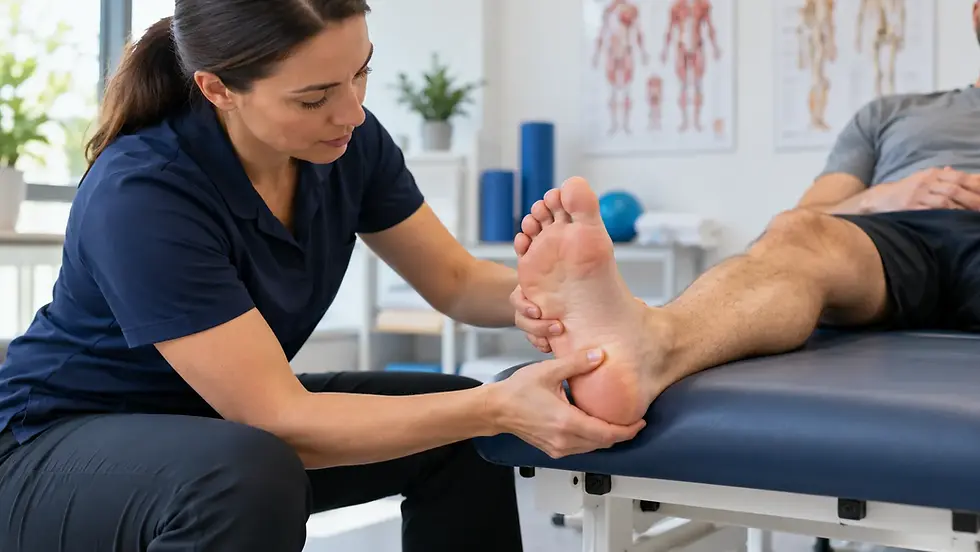
Many patients from Noida Sector 17 and surrounding areas come to The Rehab Street having never had a proper orthotic assessment — only a generic caliper or AFO fitted without clinical evaluation. Here is what a specialist assessment at our clinic actually involves:
• Detailed history: Original polio diagnosis, affected muscles, current functional level, fall history, existing devices, and activity goals
• Manual muscle testing: Systematic strength grading at the hip, knee, ankle, and foot — the clinical foundation of the entire orthotic prescription
• Gait analysis: Comprehensive walking observation identifying every compensatory movement and its structural cause
• Joint range of motion assessment: Testing for contractures, spasticity, or range limitations that affect device design
• Existing device review: If you bring your current KAFO or AFO, we assess whether it is still appropriate and whether it is in functional condition
• Casting or 3D scanning: A precise impression of your limb in the corrected position — the foundation for custom fabrication
• Prescription discussion: We explain exactly what device we are recommending, why, and what the expected outcomes are
• Fabrication, fitting, and gait training: Your device is built to specification, fitted, and you are guided through using it safely
• Scheduled follow-up: Orthotic care is ongoing — we schedule reviews to ensure the device continues to perform as your condition evolves
How to Reach The Rehab Street from Noida Sector 17 (2026)
Delhi Clinic — Greater Kailash 2
Address: H-13, near Balwant Rai School, Greater Kailash - 2, Masjid Moth, Greater Kailash, New Delhi, Delhi 110048
From Noida Sector 17, the Delhi clinic is approximately 25–35 minutes via the DND Flyway and Ring Road (subject to traffic). Get directions on Google Maps →
Gurgaon Clinic — Nirvana Courtyard, Sector 50
Address: Nirvana Courtyard, C-616, Market, Sector 50, Gurugram, Haryana 122018
From Noida Sector 17, the Gurgaon clinic is approximately 40–55 minutes via the DND Flyway and NH-48. Get directions on Google Maps →
No Referral Needed: You do not need a doctor's referral to book a polio leg treatment assessment at The Rehab Street. Simply contact us directly. Same-week appointments are typically available at both clinic locations.
Connect With The Rehab Street
Stay updated with patient education content, treatment videos, and clinic news across our platforms:
Website: www.therehabstreet.com
Instagram: @therehabstreet
Facebook: facebook.com/therehabstreet
LinkedIn: linkedin.com/company/therehabstreet
YouTube: youtube.com/@therehabstreet2211
Frequently Asked Questions — Polio Treatment Near Noida Sector 17
Q1. Is there a specialist polio orthosis clinic near Noida Sector 17?
While Noida has several orthopedic hospitals, there is no dedicated specialist orthotic clinic for polio leg treatment within Sector 17 itself. The closest specialist is The Rehab Street, accessible from Noida Sector 17 in approximately 25–35 minutes (Delhi clinic, Greater Kailash 2) or 40–55 minutes (Gurgaon clinic, Sector 50). No referral is required — you can book directly. For patients seeking the best doctors for polio treatment near Noida Sector 17, The Rehab Street represents the most clinically comprehensive option in the NCR region.
Q2. What is the difference between a polio caliper, KAFO, and AFO?
A polio caliper is the common Indian term for a KAFO (Knee Ankle Foot Orthosis) — a device supporting the knee, ankle, and foot from the upper thigh to the foot. An AFO (Ankle Foot Orthosis) is a shorter device covering only the ankle and foot, used when the knee is stable but the ankle or foot is affected. An HKAFO extends to the hip for patients with additional hip weakness. The correct choice depends entirely on which muscles are affected and how strong each joint is — determined by a clinical manual muscle test.
Q3. Can a polio patient from Noida get a custom KAFO made at The Rehab Street?
Yes. The Rehab Street fabricates fully custom KAFOs — in polypropylene, carbon fibre, and metal-leather — for patients travelling from Noida, Greater Noida, Faridabad, and across NCR. The process typically involves 2–3 visits: initial assessment and casting, fitting appointment, and a follow-up review. Same-week initial assessment appointments are usually available. Patients from Noida Sector 17 reach our Delhi clinic in approximately 30 minutes via the DND Flyway.
Q4. What is hand-knee gait and why is it dangerous in polio?
Hand-knee gait is a walking pattern in which the polio survivor places their hand on their thigh or knee to prevent the knee from buckling during walking — a sign of severe quadriceps weakness. While it feels like a functional solution, long-term hand-knee gait causes progressive damage to the shoulder (rotator cuff tears, impingement), wrist (arthritis), and elbow (joint stress) of the supporting arm. A correctly fitted KAFO eliminates hand-knee gait immediately, protecting the upper limb for the long term.
Q5. How much does a custom KAFO (polio caliper) cost in Delhi NCR in 2026?
Custom KAFO prices in Delhi NCR in 2026 vary by material and design. As a general guide: traditional metal-leather KAFOs (polio calipers) range from approximately ₹8,000–₹18,000; polypropylene custom KAFOs from approximately ₹15,000–₹28,000; carbon fibre KAFOs from approximately ₹22,000–₹45,000; and stance control KAFOs from ₹45,000 upward depending on the knee joint mechanism. Prices reflect the clinical assessment, casting, custom fabrication, fitting, and follow-up care included in the process. Please contact The Rehab Street for a specific quote for your clinical requirements.
Q6. What is post-polio syndrome and how does it affect orthotic needs?
Post-polio syndrome (PPS) is a condition in which polio survivors experience new muscle weakness, fatigue, and functional decline decades after the original infection — typically in their 40s and 50s. The overworked surviving motor neurons gradually fail, causing muscles that were previously compensating to weaken. For orthotic management, this means that a KAFO or AFO that was appropriate years ago may no longer provide sufficient support as PPS progresses. Signs include increasing fatigue, a feeling that the brace is no longer controlling the limb properly, new falls, or increased dependence on hand-knee gait.
Q7. Can foot therapy alongside a KAFO help polio patients?
Yes. Wearing a KAFO provides structural support but does not strengthen the muscles that remain functional. Foot therapy at The Rehab Street includes targeted exercises for intrinsic foot muscles, calf musculature, and hip stabilisers — maximising the contribution of intact muscles alongside the orthotic correction and reducing long-term fatigue. A combined orthotic and foot therapy programme consistently produces better functional outcomes than either approach alone.
Q8. Does The Rehab Street make customised footwear for polio leg length discrepancy?
Yes. Leg length discrepancy is common in polio survivors due to reduced bone growth in the affected limb during childhood. The Rehab Street provides customised orthopedic footwear with built-in heel and sole raises calibrated to the measured discrepancy, ensuring level pelvis alignment and reducing the compensatory scoliosis and hip pain that unaddressed leg length difference causes over time.
Q9. How do I know if I need an AFO or a KAFO for my polio leg?
The determining factor is knee stability — specifically, whether your quadriceps are strong enough to hold the knee extended during the stance phase of walking without support. If you can stand on the affected leg with your knee straight without pressing your hand on it and without the knee buckling — an AFO may be sufficient. If your knee buckles, locks backward, or you need your hand to stabilise it — a KAFO is required. This is assessed clinically using manual muscle testing at a specialist orthotic clinic. Do not rely on self-assessment for this decision.
Q10. How do I book a polio leg treatment appointment at The Rehab Street from Noida Sector 17?
No referral is required. You can book directly via the website at www.therehabstreet.com, or find us on Google Maps (Delhi) or Google Maps (Gurgaon). Same-week appointments are typically available. Delhi clinic: H-13, near Balwant Rai School, Greater Kailash 2, New Delhi 110048. Gurgaon clinic: Nirvana Courtyard, C-616, Sector 50, Gurugram 122018.
Final Verdict: The Best Polio Treatment Near Noida Sector 17 (2026)
If you are searching for the best doctors for polio treatment in Noida Sector 17, the honest answer is this: the most comprehensive specialist orthotic care for polio in the NCR is available at The Rehab Street — not within Sector 17 itself, but accessible from it within 30–55 minutes. No general orthopedic hospital in Noida combines clinical assessment, gait analysis, in-house custom KAFO fabrication, carbon fibre options, stance control technology, post-polio syndrome management, and customised footwear under one roof the way a dedicated orthotic clinic does.
Polio leg treatment is not about finding the most famous hospital or the most senior surgeon. It is about finding a specialist who understands your specific muscle weakness pattern, can design a device that addresses it precisely, and provides the follow-up care to ensure it continues to work as your condition evolves over time. That is what The Rehab Street exists to provide — for patients in Noida, across NCR, and across India.


Comments